
The Living Lab
June 15, 2026
By Michelle Strickland
The University of Kansas Cancer Center’s new facility is engineering a cancer-free future.
The University of Kansas Cancer Center’s current story is one of hope wrapped in steel beams and the thrumming sounds of a building project in progress. But the true narrative isn’t in the steel—it’s in the science of time.
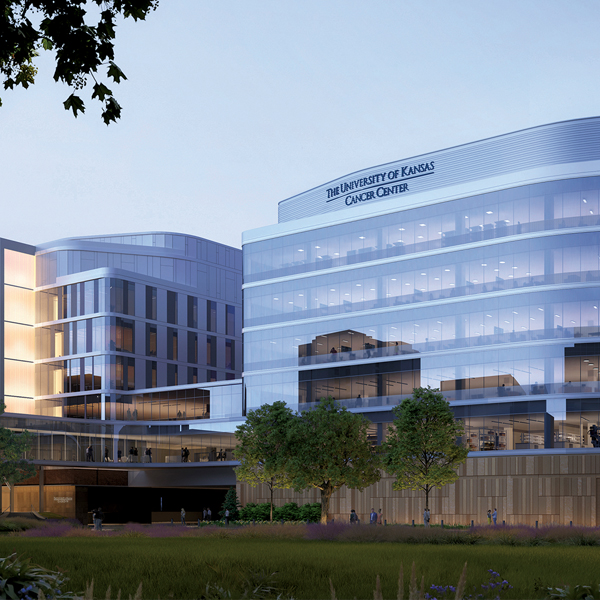
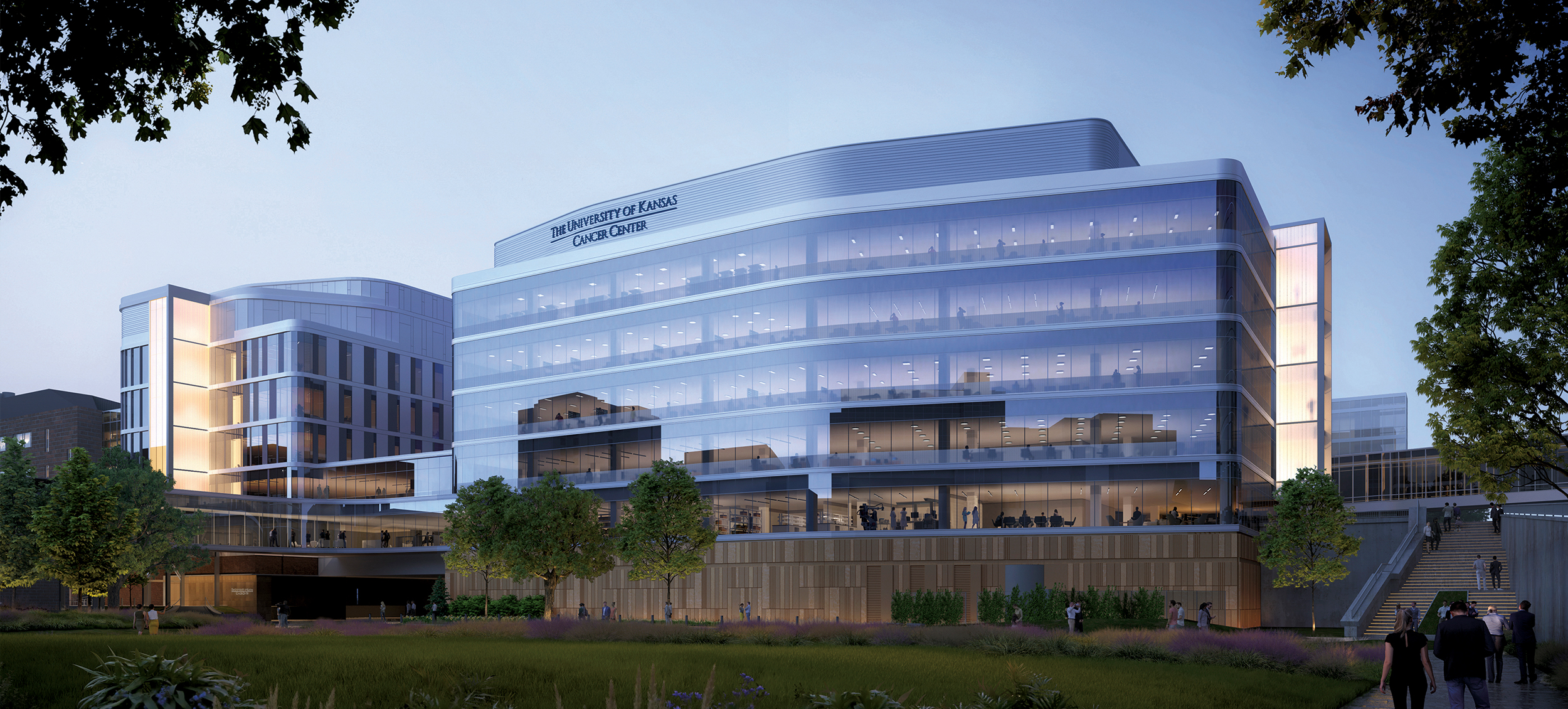
In the world of oncology, time is the only currency that matters. It is the time a patient waits for a clinical trial, the time it takes to bioengineer a drug, and ultimately, the time a survivor gets back with their family. With the rise of KU Cancer Center’s new $575 million global-destination facility, the region is poised to reclaim time. This extends beyond world-class patient care and cancer research; the building represents a specialized engine designed to position KU Cancer Center at the forefront of the global cancer landscape through the power of cellular therapy.
After a May 2025 groundbreaking, construction cranes towering over 39th and Rainbow in Kansas City, Kansas, have become a fixture of the skyline, with the new facility slated to open in fall 2027. The skeleton of the building taking shape at the site signals what is to come and represents one of the academic medical center’s most ambitious projects to date, one that will bring researchers and clinicians together for the collaboration needed to cure cancer.
Anniversary of a miracle
June 2026 marks one year since Anthea Scouffas, the engagement and education director at the Lied Center of Kansas and a beloved figure in the Lawrence arts community, underwent a “Hail Mary” procedure that saved her life: chimeric antigen receptor (CAR) T-cell therapy.
After going through treatment for aggressive large B-cell lymphoma with traditional chemotherapy and radiation, Scouffas was determined to live her life.
She and her partner, Sharon Graham, were determined to follow through with a long-planned vacation, and they were traveling in Poland when Scouffas’ symptoms worsened. It was obvious the cancer had returned with a vengeance.
Upon her return to Kansas, she transferred her treatment to The University of Kansas Cancer Center under the care of Dr. Marc Hoffmann, oncologist and lymphoma program director. The first step was a grueling stem cell transplant preceded by intense chemotherapy and radiation. Three months later, the cancer—smart, relentless and adaptive—had returned, and was more aggressive. She was running out of road, but the next stop was CAR T-cell therapy. During the treatment, her own cells were removed and bioengineered to become hunters of the malignant cells. It didn’t just treat the disease—it melted it away.
“I remember one of the doctors peeking her head into the room and saying, ‘It’s gone.’ The nurses were crying,” Scouffas recalls. “And that science was available right here, practically in my own backyard.”
Eliminating wait times
Currently, the process that saved Scouffas involves a significant logistical hurdle. When a patient needs CAR T-cell therapy, their T cells are harvested at KU Cancer Center, frozen, and then shipped to commercial pharmaceutical labs as far away as New Jersey. There, they are bioengineered and shipped back weeks later. For a patient with an aggressive lymphoma, those weeks are a dangerous gamble.
KU’s new cancer center building will change the math entirely. One essential component of the facility is a state-of-the-art Good Manufacturing Practice (GMP) laboratory, made possible by a $10 million gift from the Cinelli Family Foundation.
“One of the reasons we wanted to give specifically to the GMP laboratory is because right now, CAR T cells are being shipped out and sent back, and that’s time some of these patients don’t have,” says Eric Ryan, Cinelli Family Foundation deputy executive director, secretary and treasurer. “If things can be done in-house, we can really speed up the process and further both research and saving lives. It’s a win-win.”
Reflecting on the anxiety that came with the wait, both for Scouffas and for herself, Graham says the future facility’s ability to cut the wait time will be everything to patients and their loved ones.
“When you are fighting a cancer that grows by the day, those weeks are everything,” Graham says. “You don’t have to go anywhere else. You get the best options right here at KU.”
This in-house capability is what fuels the early-phase clinical trial dubbed “Triple Threat,” led by Dr. Joseph McGuirk, division director of the hematologic malignancies and cellular therapeutics program, and Scott Weir, PharmD, director of the Institute for Advancing Medical Innovation at KU Medical Center and an investigator on the trial. While traditional CAR T-cell therapies target one marker on a cancer cell, the Triple Threat targets three. It is a more sophisticated “search and destroy” mission, which makes developing resistance significantly harder for cancer cells.
“Cellular therapy has profoundly changed the way we treat some cancers, yet many patients who would benefit from these treatments don’t have access,” McGuirk says. “One of our strategies for increasing that access is expanding our manufacturing capacity to produce these treatments locally.”
By bringing cancer research and patient care together, the transition from research to treatment will move at a velocity previously unseen in the region.
The path to comprehensive excellence
This leap in research capacity is the direct result of KU Cancer Center earning the National Cancer Institute’s designation as a comprehensive cancer center. Achieved in 2022, the designation is the highest level of recognition granted by the National Cancer Institute and a status held by fewer than 60 institutions nationwide.
The journey to this designation took nearly 20 years of relentless growth under the vision, determination and leadership of Dr. Roy Jensen, vice chancellor and director of the cancer center. It required a massive investment in intellectual capital, growing the cancer center team from a handful of staff to a powerhouse of over 350 world-class investigators and clinicians.
The new physical space not only supports and streamlines the current work, but it will enable the cancer center to recruit top talent from across the country.
The new center is designed to unite efforts of researchers and clinicians. In older models of medicine, researchers worked in one building while clinicians saw patients in another. In the new facility, the person writing the protocol for a new cellular therapy might share a coffee break with the doctor administering it. This synergy is how the cancer center plans to stay ahead of the curve, attracting patients from around the globe who are seeking leading-edge care.
“Cellular therapy is advancing rapidly, and the University of Kansas Cancer Center must be at the forefront,” Jensen says. “Recruiting the right people and training the next generation are among the goals that set us on a clear path to grow our research portfolio, strengthen our team and ensure patients have access to the therapies they need.”
An outreach epicenter
Statistics published in the research journal Frontiers in Oncology show that up to 30% of patients who qualify for advanced cellular therapies never receive them, often because of geographic access. If you live in a rural county, the logistical burden of multiple trips to a city five hours away can make lifesaving care feel out of reach.
The new building will serve as the hub of a wheel with spokes that extend across the state via the Masonic Cancer Alliance, the cancer center’s outreach network. By centralizing the most complex manufacturing and research in Kansas City, KU Cancer Center can more effectively support rural communities, ensuring that a ZIP code does not determine a survival rate.
The cancer center and the Masonic Cancer Alliance recently launched a new effort to provide more cancer screenings throughout the cancer center’s catchment area with HOPE on Wheels: Health Outreach, Prevention and Education. Those wheels carry a 42-foot bus that serves as a mobile screening unit, with funding for the bus provided by the Kansas Masonic Foundation and funding for its operation provided by the Cinelli Family Foundation.
HOPE on Wheels will bring early detection—and a sense of well-being—to towns across Kansas and western Missouri. Among other services, it will offer skin cancer screenings, prostate cancer screenings, breast cancer screenings, take-home colorectal cancer screening kits and tobacco cessation resources. The bus began operation in May.
The humanity of the gift
As the outline of the new facility fills in over the next year, the focus remains on the people inside. For Scouffas and Graham, their experience transformed their perspective on philanthropy. They have established the Scouffas-Graham Blood Cancer Research Fund to ensure that future patients have the same lifesaving options that Scouffas did.
“What price do you put on the science that saves a loved one?” Graham asks. “We live in a time where federal dollars are stretched. It is up to the community to ensure these researchers have the ‘bridge funds’ they need to keep going between grants. Because at the end of the day, cancer doesn’t care about politics. It affects everyone.”
Scouffas, now healthy and looking forward to traveling and “doing life,” says her experience at KU Cancer Center was more than just science in action—it was humanity in action.
“Sometimes I’ll sit on the front porch and look up at the night sky and just be giddy thinking, ‘I’m alive,’” she says. “And I cannot say enough about how KU Cancer Center made that possible for me. Not only are they amazing experts, they are amazing people, too.”

This feature and more are included in the inaugural Spring 2026 issue of Crimson & Blue magazine, co-published with KU Alumni and the University of Kansas.
KU Endowment is the independent, nonprofit organization serving as the official fundraising and fund-management foundation for KU. Founded in 1891, KU Endowment is the first foundation of its kind at a U.S. public university.
Posted on
June 15, 2026

Share this article
Connect with Us