KU’s approach to improving cognitive care
November 16, 2026
As Alzheimer’s cases in the U.S. continue to rise, the work of KU researchers and clinicians to improve detection and treatment will shape the future of healthcare.
By Chandra Blackwell
Anyone who’s ever had to prepare for a test is familiar with strategies for memorization—“cheat codes” for the human brain that can help it organize information in a memorable way. These include repetition, mnemonics and storytelling—the latter of which can be particularly effective, as it connects disparate pieces of information by arranging them into a meaningful sequence.
Now, imagine a patient in a physician’s exam room. Prior to the exam, the patient is given three words to remember and will be asked to repeat them at the end of the exam as part of what’s known as the “Mini-Cog,” a test physicians use to check for cognitive impairment in older adults. The words are apple, table and penny.
At the University of Kansas Medical Center, teams of experts are weaving a story in which these three words become meaningfully connected—a yearslong endeavor that, in its continued progress, will touch the lives of countless individuals and families, particularly those who call Kansas home.
Retired Kansas City physician Brent Beasley saw his life take a sudden detour when the systems that had shaped it for decades began to break down. For many of his 57 years,Beasley had found meaning in both his church, where he served as a deacon, and clinic, where he cared for patients. Both were places where the initial signs of something amiss began to appear.
At church, Beasley noticed he struggled with the sequence of the service. “When I was at my sickest,” he says, “I was a real mess in the altar. I struggled to remember my cues, and people were having to guide me around and show me what I was supposed to be doing.”
Such help was a luxury he didn’t have at work. After 31 years as an internal medicine physician—during which he oversaw a medical practice and ran an academic clinic where he taught medical students and residents—“I got fired,” Beasley says. He’d been fumbling tasks he used to handle with ease, repeating himself to patients and losing track of daily duties. “(My supervisor) called me into her office, sat me down and said, ‘You’re done.’”
Beasley’s difficulties had started after he’d contracted what he calls “the most mild case of COVID.” Soon after, he began having trouble with his memory, which he and his wife attributed to COVID fog. “I recall that fog, the constant feeling like I was forgetting something—which I was—and knowing memory was just beyond my reach,” Beasley says.
He sought advice from a neurologist colleague, who sent him to The University of Kansas Health System’s Memory Care Clinic. After a battery of tests, Beasley finally had an answer to his mysterious plight: early-onset Alzheimer’s, a diagnosis given to those affected by the disease before age 65. Among the estimated 7 million people in the U.S. who are living with some form of dementia, roughly 200,000 have the early-onset diagnosis.
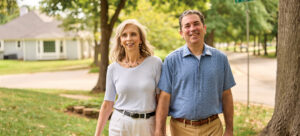
In Kansas, Alzheimer’s is the seventh leading cause of death. About 19% of Kansans older than 45 report subjective cognitive decline, and, according to the Kansas Department for Aging and Disability Services, more than 140,000 active caregivers provide more than 127 million hours of unpaid care annually for dementia patients. Add in a severe shortage of neurologists and geriatricians west of Wichita, and ensuring Kansans have access to optimal cognitive care is a significant challenge—one the KU Alzheimer’s Disease Research Center has partnered with The University of Kansas Health System to help solve.

Apple: What we know
Knowledge about Alzheimer’s disease and dementia has expanded tremendously over the past 20 years, and the KU Alzheimer’s Disease Research Center (KU ADRC) is leading work that continues that expansion.
Dr. Jeffrey Burns, m’98, g’09, who co-leads the KU ADRC with Dr. Russell Swerdlow, came to KU Medical Center in 2004 with the goal of building a National Institutes of Health-funded program that would create vast improvements in cognitive care in the Kansas City metro. He started the Alzheimer’s Clinical Research Program that same year—no easy feat, as, typically, earning an NIH grant for a particular area of research requires an established research environment, and such an environment for Alzheimer’s research didn’t yet exist at KU, Burns says.
“There were pieces here,” he says. “There was, I think, $100,000 of annual NIH research funding in the area of aging and Alzheimer’s disease coming to campus in 2004. There had been an Alzheimer’s center five or six years previous, but it was basically gone. And there was a little bit of memory care going on in the (University of Kansas Health System’s) neurology clinic. We sort of built a nucleus from that, and it grew.”
This feature and more are included in the inaugural Fall 2026 issue of Crimson & Blue magazine, co-published with KU Alumni and the University of Kansas.
KU Endowment is the independent, nonprofit organization serving as the official fundraising and fund-management foundation for KU. Founded in 1891, KU Endowment is the first foundation of its kind at a U.S. public university.
Posted on
November 16, 2026
Share this article
Connect with Us