By Rylie Oswald
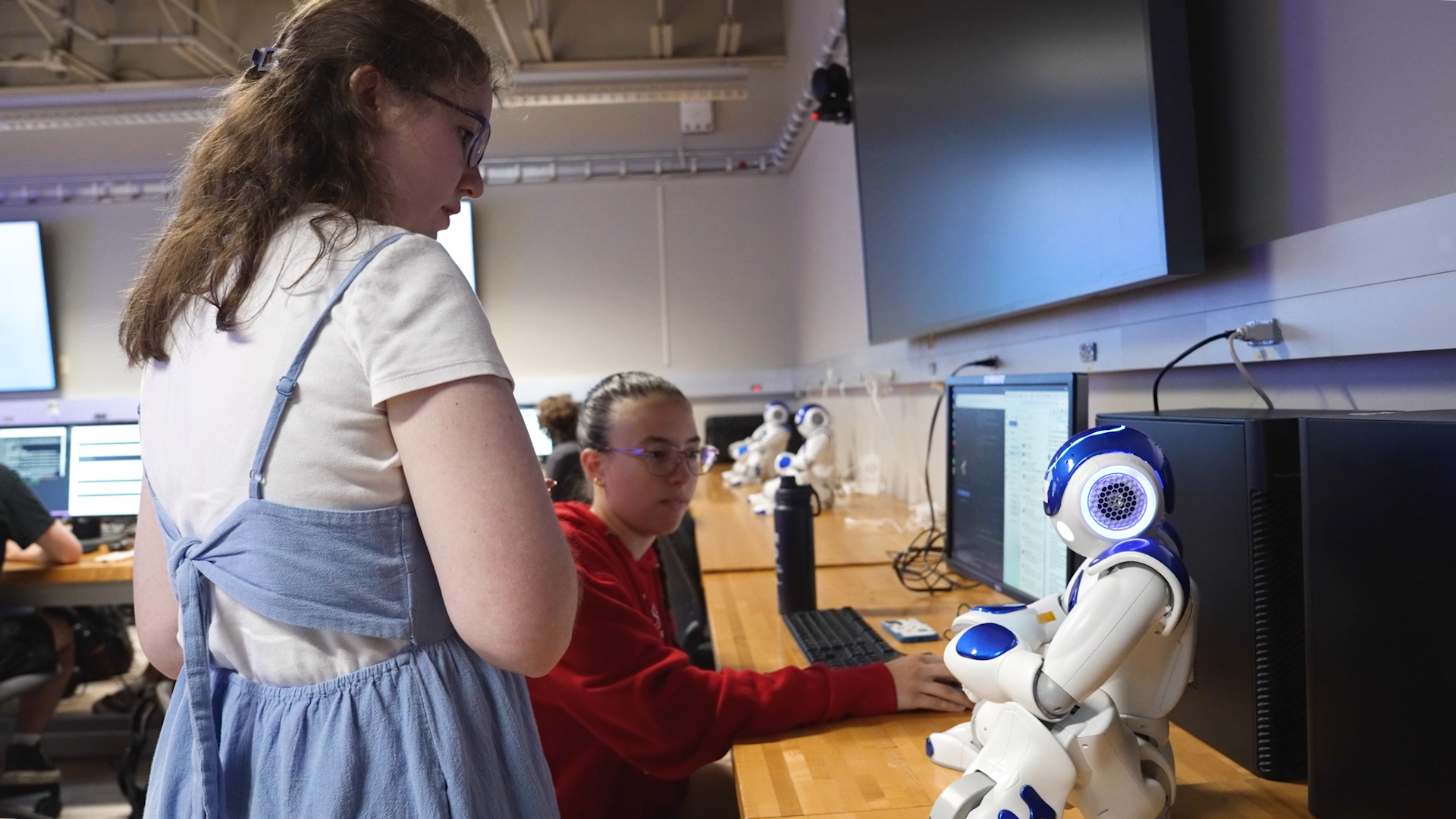
A student writes a line of code, and the small, humanoid robot on the desk tilts its head and speaks in a high, melodic voice. Other students place robots on the classroom floor where they take wobbly steps, resembling clumsy toddlers, driven by code.
Assistant Professor Sarah Sebo teaches this class on human-robot interaction (HRI) in the Department of Electrical Engineering and Computer Science at the University of Kansas. Students study how humanoid robots interact with humans and how humans perceive them, based on how humanlike the robots are. Sebo’s own research focuses on robot tutors, specifically using robots to tutor elementary school children in math, reading and social emotional learning.
“My work looks at how we can best design robot behavior to engage students in a way that they can learn the most and benefit the most from a tutoring robot,” Sebo said.
Sebo came to KU from the University of Chicago in August, and she already has a robotics lab where undergraduate and graduate students research HRI. The Socially Engaging roBOtics (SEBO) Lab is split between the University of Chicago and KU, with students participating across both campuses.
“I invite undergrads to join every part of the research process, from coming up with ideas for projects to running human subject studies, programming robots, analyzing data,” Sebo said. “Several of the undergraduates who have worked with me in the past have gone on to publish first-author papers in the top conference in our field.”
Eva Broksas, a sophomore in mechanical engineering, is one of the undergraduate researchers in the SEBO Lab. Since she began working with Sebo, she has already gained invaluable interdisciplinary skills and seen how her coursework translates to the lab.
“I’ve gotten invested in learning how to program the robots,” Broksas said. “This morning I got to learn how to program in Kotlin programming language. Even in the two months I’ve been with the research group, I’ve learned a plethora of information on software and programming, which I might not touch in mechanical engineering courses.”
HRI combines engineering and psychology. Recently, SEBO Lab met with Counseling and Psychological Services (CAPS) on campus to discuss how robots would be best used in assisting counseling sessions. Broksas describes this convergence of robots and therapy as a “new frontier.”
“We’re looking at the difference between an AI chatbot assisting versus a literal, physical embodied robot assisting in the positive psychology or other therapy processes, and how that changes either the psychological growth or the progress,” Broksas said.
Sebo has been interested in the intersection between robots and humans from the moment she saw a robot doing something “intelligent,” such as navigating a maze and using its sensors to gauge its surroundings.
“The moment I saw my code work on a robot in person for the first time was this magical moment, seeing my code come out of the confines of the computer and actually move something in the real world,” Sebo said. “And then once I started my graduate study, I got really interested in psychology and people and thinking about that interface between robots and people.”
Samantha Adorno, a senior in computer science and another student researcher in SEBO Lab, thinks robots will be more widespread in coming years. To Adorno, research analyzing how robots can effectively interact with humans is the best way to be prepared for this future.
“It will be very interesting to see how robots and humans help each other mutually,” Adorno said. “There are things that humans do better than robots, and there are things that robots do better than humans. There are areas where we can complement each other.”
If you would like to help KU Engineering student researchers venture into the “new frontier,” contact Zayra Montalvo, associate director of development at KU Endowment, at 785-832-7353 or [email protected].